

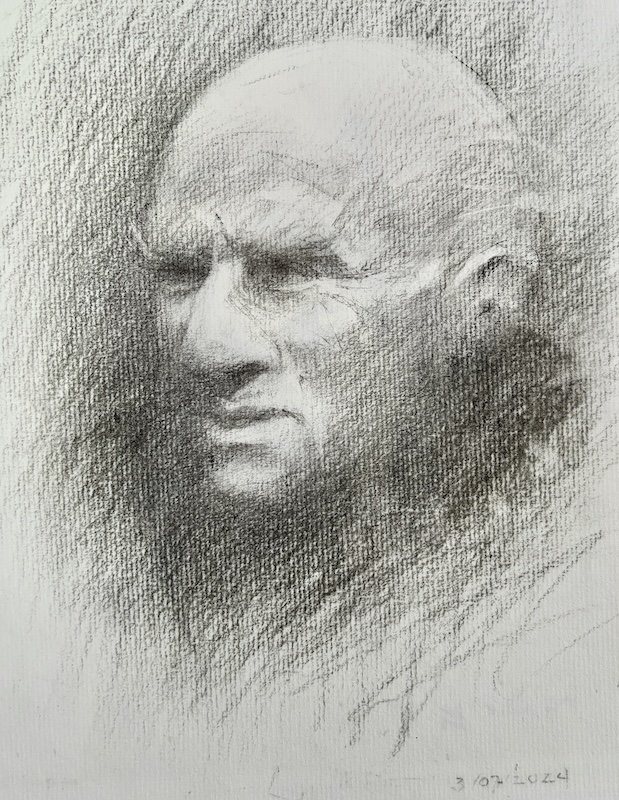
One of my side-passions is to find ways to “practice” portraiture. I’m deeply interested in how to draw the human countenance, and hopefully bring the drawings to life. I prefer to work these out without troubling a sitter, so I’ve been quietly cultivating a practice of drawing from imagination for a number of years. It’s truly an endless pursuit, but one I enjoy immensely.
I teach often enough with live models to get in regular classroom time with sitters, and I’m an avid sketcher of people in public. But I’ve long felt that what I could draw WITHOUT any model or reference was the measure of my actual ability.
For the sake of presenting these to you, I decided to call them The Made-Up People. It’s really what they are.
How It Works
The practice usually starts with some time in the evening when things have quieted down. Maybe some music or a film running. I’ll start with a nice piece of firm charcoal and a charcoal paper pad (9 x 12″) and usually draw an oval around the center of the sheet. I’ll be thinking about something I’ve seen, or someone whom I might enjoy meeting. Or someone I’d rather avoid. Depends on my inclination and mood, but I never have a firm intention on a particular individual in mind. My portrait is going to be a construct of impressions gathered from memory.
Older faces often come to mind, they’re always interesting, and easier to develop than the young. Youthful faces require much less line, and so the placement of features (always a prime concern anyway) has to be utterly precise. But whichever direction I take, it’s always a journey from a few general marks to gradual construction until something takes form.
I try to vary angles of the head and lighting, but most of all to invest them with an actual emotion. Many times gender doesn’t enter the equation until after getting the basic head established. Then I’ll think about what would be a good addition, what sort of persons I have yet to add to my little informal collection.
I’m never concerned with finishing anything in a timely manner. If one starts to come alive on the page, I can return to it anytime when I’m ready. A drawing can be in my pad for months, and I may come back to it or not. Some have been worked on for hours, dusted off, and resumed. But any drawing can still possibly be abandoned if things persistently don’t hold together or aren’t interesting enough.
The Biggest Lesson
The biggest lesson I’ve learned from this is I can clearly see what part of the head I don’t have enough knowledge of. The things you don’t truly understand about the human head become apparent when making these. From that, I know to start looking more. That’s why it’s a good exercise.
What follows are a few of the more presentable drawings.
ABOVE: “Hard-Bitten”, a character suggested by listening to an audio reading of “A Tale of Two Cities”. Charcoal on laid paper, 9 x 12″.
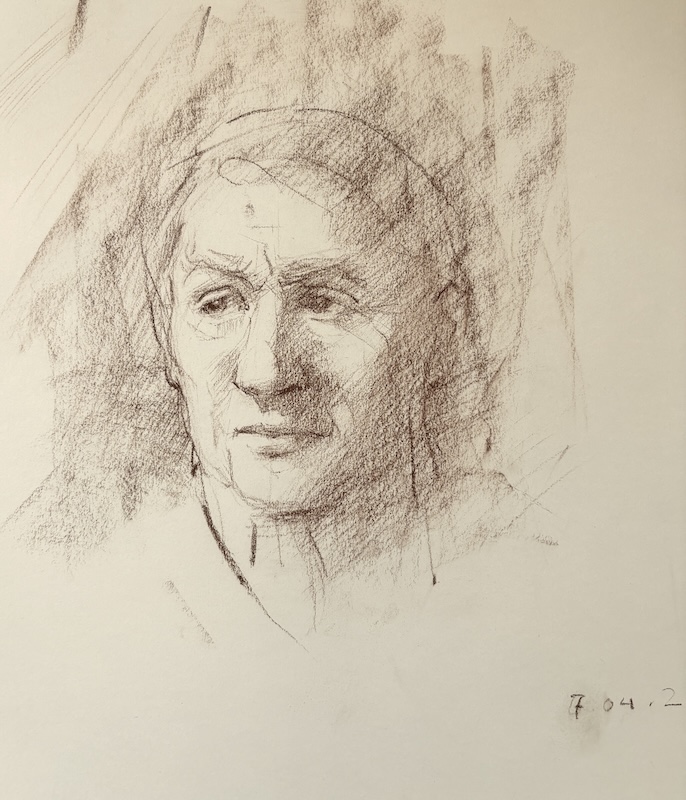
Sepia Conté on ivory paper.
]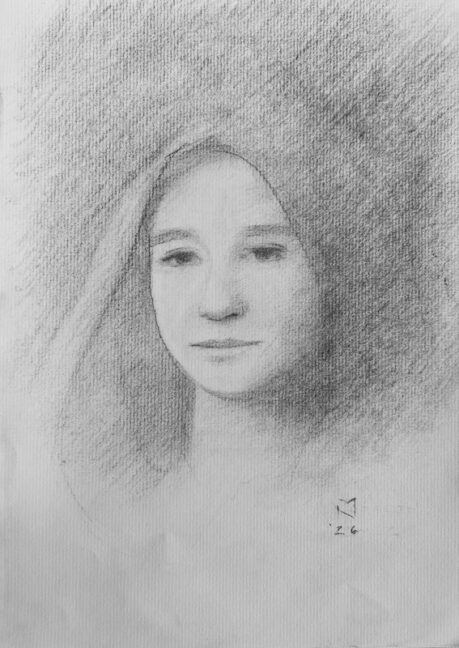
9 x 12″ charcoal on laid paper. This young woman’s head was actually dusted-off and redrawn multiple times. A valuable technique, but one which only seems to work well with charcoal.
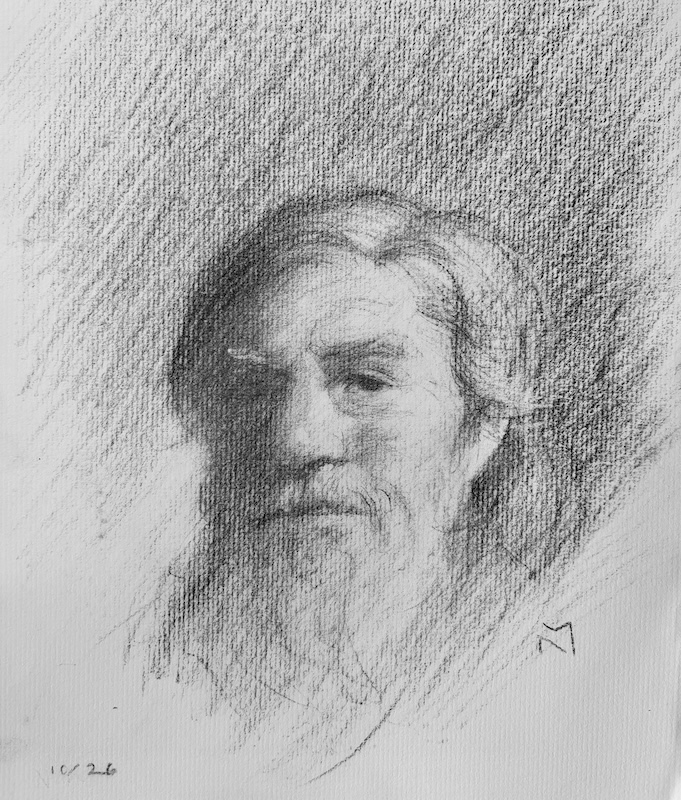
Charcoal on laid paper, 9 x 12″. Originally intended as an older female, the direction gradually shifted to a rather interesting looking elderly man.
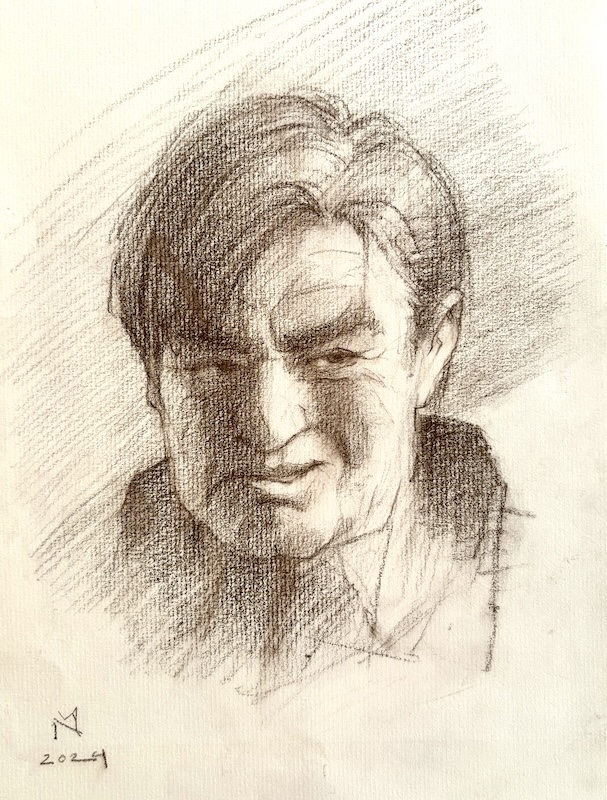
Sepia Conté on ivory paper 9 x 12″. A character suggested from viewing an old film I had watched. Curiously, I find that contempt, or any strong negative emotion, is not difficult to draw. However the positive emotions are a much different matter, requiring much more sensitivity and micro-adjustments.
I’m indebted to a number of excellent artists that came before us for the inspiration behind this. Sources such as drawing catalogues from past exhibitions, my collection of older books on drawing, and finding occasional treasures in galleries and museums over the years have kindled and fed this activity. I especially mention artists Henri Fantin-Latour, Léon L’hermitte, Pascal Dagnan Bouveret, and John S. Sargent, as some key sources of inspiration and motivation.
I welcome your questions and responses.